Shasta meets Aslan
The Horse and His BoyShasta meets Aslan on a dark road, believing at first that the immense, unseen presence pacing beside him may be a giant or a ghost. The encounter becomes the turning point in his understanding of his journey: the lions he had counted as separate disasters were Aslan, guiding him toward the people and places he needed to reach. As dawn reveals the Lion, the frightening companion becomes at once the source of Shasta’s hardships and the guardian who has carried him through them.
The Unseen Companion
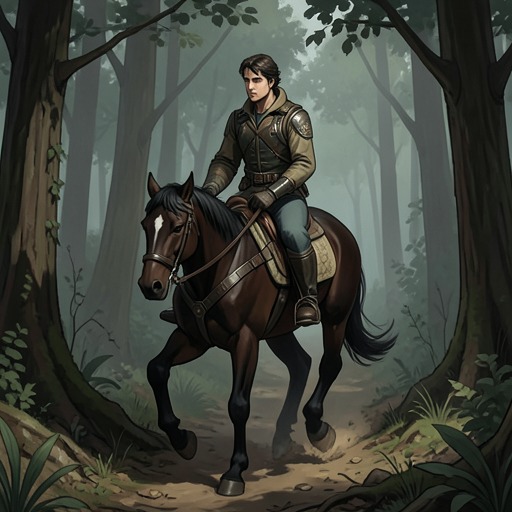
Shasta is already exhausted and hungry, and has been lamenting that everyone else has found safety while he alone has been sent onward. A sudden awareness interrupts his self-pity: something is walking beside him in the pitch-dark mist. It moves so quietly that he cannot tell how long it has been there; its breathing, however, is so immense that Shasta imagines a very large creature. The thought of giants in the Northern countries frightens him into silence.
The presence continues beside him, and a deep sigh sends warm breath against Shasta’s chilly hand. He cannot flee: the horse is not capable of a gallop, and Shasta does not know how to make it gallop even if it were. Forced to continue at a walking pace alongside the invisible being, he finally whispers, “Who are you?” The answer—“One who has waited long for you to speak”—makes the encounter seem not like a chance meeting but a conversation long deferred.
Shasta still cannot see his companion. Fearing first that it is a giant and then that it may be dead, he pleads for it to go away and again declares himself the unluckiest person in the world. The warm breath on his hand and face reassures him that the presence is no ghost. It invites him to tell his sorrows, shifting the scene from a test of physical courage to an exchange in which Shasta must give an account of his life.
Shasta’s Story and the Lion’s Answer
Shasta recounts the hardships that have shaped his sense of misfortune: he never knew his real parents and was raised sternly by the fisherman; he escaped with his companions, was chased by lions, and had to swim for his life. He recalls the dangers in Tashbaan, the night among the tombs, the howling beasts in the desert, the heat and thirst of the crossing, and the lion that chased them near their goal and wounded Aravis. He ends with the immediate fact of his hunger, bringing the long sequence of dangers back to his tired, empty body.
The immense voice rejects Shasta’s conclusion that he is unfortunate. When Shasta asks whether meeting so many lions was not bad luck, the answer is, “There was only one lion.” The contradiction unsettles his understanding of the journey: what appeared to be a series of separate attacks and terrors was the action of one being, whose identity had remained hidden from him.
Aslan names the episodes one by one. He was the lion who forced Shasta to join with Aravis; the cat who comforted him among the houses of the dead; the lion who drove jackals away while he slept; and the lion who gave the horses a new strength born of fear during the last mile, so that they would reach King Lune in time. He also identifies himself as the lion Shasta cannot remember: the one who pushed the boat carrying him as a nearly dying child toward the shore, where a wakeful man received him at midnight. The revelation reaches beyond the recent desert crossing and connects it to the beginning of Shasta’s life.
Shasta asks whether Aslan was also the lion who wounded Aravis, and Aslan confirms it. When Shasta asks why, the answer sets a boundary: “I am telling you your story, not hers. I tell no one any story but his own.” The disclosure explains the injury as part of the events Aslan is recounting to Shasta, but it does not explain Aravis’s story or motives. The meeting therefore gives Shasta a new understanding without making him the interpreter of another person’s experience.
Recognition at Dawn
Asked who he is, the voice answers, “Myself,” three times, each with a different sound: deep and low, loud and clear, then almost inaudibly soft, seeming to come from all around. Shasta is no longer afraid of being eaten or haunted. Instead, another kind of trembling comes over him, mingled with gladness. The exchange has changed the quality of his fear before the speaker’s appearance confirms its identity.
The mist has been shifting from black to gray and from gray to white while Shasta has been talking. Now its whiteness shines, birds can be heard ahead, and he can see the horse’s head, ears, and mane. Golden light falls from the left. When Shasta turns, the source of the light is visible: a Lion pacing beside him, taller than the horse. The horse does not seem afraid, or perhaps cannot see the Lion. Shasta, who has not heard the true stories of Aslan, recognizes the Lion not through prior knowledge but through the force of his face.
He slips from the saddle and falls at the Lion’s feet, unable to speak and feeling no need to speak. Aslan stoops toward him; the mane and its solemn perfume surround Shasta, and the Lion touches his forehead with its tongue. Their eyes meet. The mist’s pale brightness and the Lion’s fiery brightness then whirl together, gather, and disappear. Shasta is left alone with the horse on a grassy hillside beneath a blue sky, with birds singing.
Meaning and Consequence
The scene reverses the emotional meaning of Shasta’s journey without denying what happened to him. The pursuit, terror, injury, and exhaustion were real; what changes is his recognition that they were not a succession of unrelated accidents. By naming each episode, Aslan makes the journey legible as a continuous course of guidance, extending from Shasta’s arrival as a child to the desperate final ride toward King Lune.
The encounter also gives form to the difference between experiencing events and understanding their pattern. Shasta has lived through the journey piecemeal, often interpreting each new hardship as proof that he is uniquely unlucky. Aslan’s list joins those moments into a single account, but its limit is as important as its revelation: Shasta is told his own story, not Aravis’s. The scene grants him recognition and reassurance while preserving another person’s story as her own.
Its imagery carries the change from concealment to recognition. At first Shasta can perceive only breathing and warmth in darkness; gradually the mist brightens, birds announce morning, and the Lion’s light becomes visible. The revelation ends not in a continued explanation but in disappearance, leaving Shasta in an ordinary landscape of grass, sky, horse, and birds. The transformed understanding remains with him after the dazzling encounter itself has passed.